
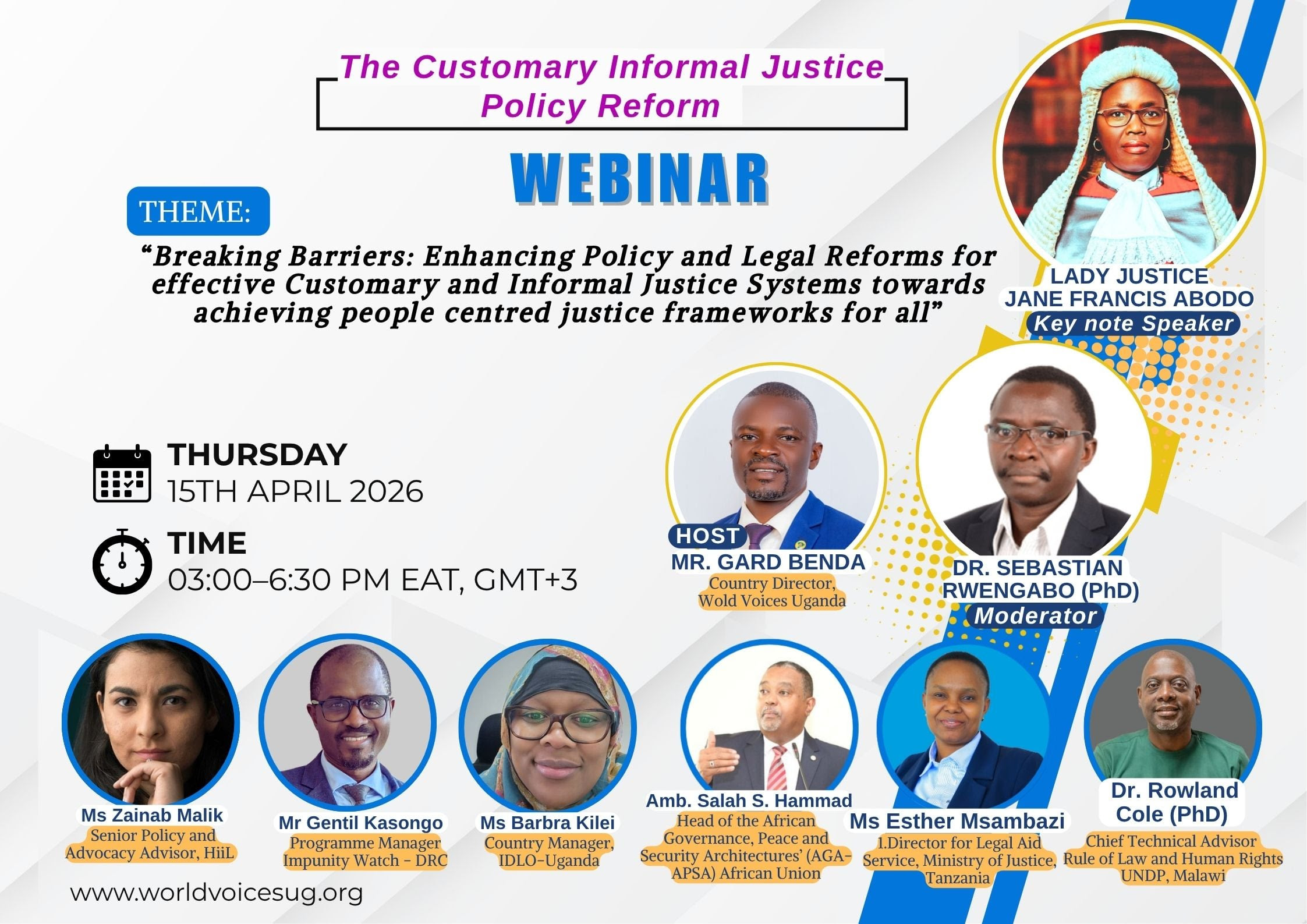
We are delighted to invite you to the Customary Informal Justice Policy Reform webinar on Wednesday 15th April, 2026 starting at 03:00 pm to 6:30pm (EAT, GMT +3 hours).
Theme
“Breaking Barriers: Enhancing Policy and Legal Reforms for effective Customary and Informal Justice Systems towards achieving people centered justice frameworks for all”
The webinar aims to foster a focused dialogue on reforming policy and legal frameworks to strengthen customary and informal justice systems as accessible, legitimate, and accountable avenues for people-centered justice. It will identify gaps, challenges, and opportunities for aligning these systems with national justice goals and community needs.
The session will also showcase best practices and innovative approaches for integrating customary and informal justice with formal judicial structures, enhancing access, accountability, and community participation. Additionally, it will explore strategies to build capacity, overcome cultural barriers, and establish effective linkages between CIJS and formal justice systems for more inclusive and efficient justice delivery.
This webinar will unite government, civil society, CIJS actors, and international partners to discuss policy and legal reforms needed to strengthen CIJS as vital, people-centered justice avenues. It will emphasize the importance of linking CIJS with formal justice systems to ensure effective, unified access to justice across Sub-Saharan Africa.
Click Here to Register
We look forward to your participation. Together, let’s redefine the narrative around the integrity of CIJs towards achieving access to justice for all
Background and Rationale
This upcoming webinar builds on key recommendations from the September 2024 Regional Conference on Customary and Informal Justice Systems (CIJS) held in Kampala. It responds to growing recognition that CIJS are central to expanding access to justice, particularly for underserved and rural populations, yet remain inadequately supported by formal policy and legal frameworks. Globally, an estimated 70–80% of disputes are resolved through CIJS, with over 80% of cases in Sub-Saharan Africa relying on these systems. Despite handling the majority of disputes especially for women, children, persons with disabilities, and other vulnerable groups CIJS continue to face limited legal recognition, weak institutional support, and accountability gaps, which undermine their effectiveness, legitimacy, and long-term sustainability.
Context and Need for Dialogue
While CIJS provides accessible, culturally grounded justice, they often operate within fragmented or unclear legal environments that constrain their potential and may perpetuate inequality or human rights concerns. Many governments have yet to fully integrate these systems into national justice frameworks, resulting in inadequate resources, limited capacity, and a persistent disconnect between formal justice institutions and community realities. This webinar is therefore designed to advance critical dialogue on strengthening policy and legal recognition of CIJS, aligning them with national, regional, and international justice agendas, and ensuring they contribute meaningfully to inclusive, people-centered justice systems. It will bring together stakeholders from government, civil society, customary justice institutions, and international organizations to share comparative experiences and identify practical reform pathways.
Advancing Reform and People-Centered Justice
The session will focus on exploring innovative approaches to integrating CIJS with formal justice systems while addressing persistent challenges such as weak institutional support, limited capacity, cultural barriers, and the need for stronger accountability and human rights protections. By fostering collaboration and knowledge exchange, the webinar seeks to catalyze responsive policy and legal reforms that enhance the legitimacy, efficiency, and accessibility of CIJS. Ultimately, it aims to promote sustained engagement through follow-up advocacy, knowledge sharing, and capacity-building initiatives, ensuring that CIJS are strengthened as credible, inclusive, and people-centered mechanisms for delivering justice.