
Project Description
Three year project funded by the Democratic Governance Facility ( DGF) was implemented by World Voices Uganda in Albertine and Rwenzori regions. The project aims at contributing to enhanced access to justice, and human rights protection for vulnerable and marginalised rural population, enabling them to access fair and accountable justice services delivery and meaningfully participate in local level decision making in administration of justice. Target beneficiaries include the marginalised, indigent and voiceless people such as orphans and vulnerable children, youth, widows, persons with disabilities, women, victims of human and land rights abuse, and inmates and suspects. Other beneficiaries are duty-bearers such as CSOs, local leaders and policy-makers, members of the Justice Law Order Sector institutions such as police, prisons and state prosecutors.
Key Results/Impact
1. WVU supported over 6,700 grassroots community members to obtain access to justice services through formal and informal justice mechanisms.
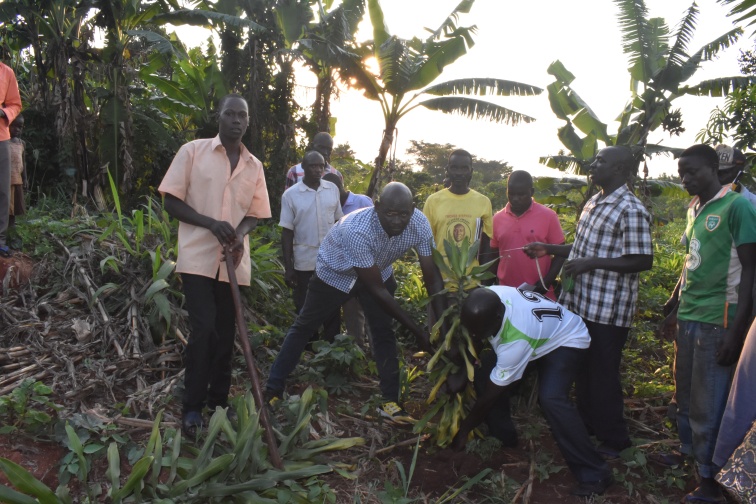
2. WVU handled and resolved 2,285 land disputes and other matters arising in the community. Through its informal justice mechanisms such as the Bataka Courts, WVU has spearheaded several local reconciliation efforts, which contributed to resolving complex land and domestic disputes. To date, WVU has established and strengthened a total of 10 Bataka Courts in the districts of Kagadi and Kyegegwa. In the past two years, these Bataka Courts handled and disposed 449 cases.
3. WVU has also been able to enhance community led access to justice mechanisms at the grassroot levels hence enabling the communities’ access justice in real time at low a cost. This was through Community Legal Volunteers, training of informal justice actors and panel of Elders to take part in administration of justice at no cost. As such this has led to reduction of case backlog in local courts especially at local council and Magistrates courts. \
4. The project has contributed to strengthening the relationship and coordination between formal and informal justice systems. In the past 2 years, WVU saw a total of 259 cases being referred between the two forms of justice (formal and Informal).
5. WVU has undertaken three studies on access to justice, namely : (i) Mapping Report of Justice Needs and Existing Access to Justice Structures in the Delivery of Access to Justice in the Albertine and Rwenzori regions; (ii) Mapping Exercise of Informal Justice Mechanisms practiced in Kyaka II Refugee Settlement Camp in Kyegegwa District; and (iii) Capacity Assessment Report of Informal Justice Actors in Delivering Justice in Accordance with Constitutional Requirements and International Human Rights Standards in Albertine and Rwenzori regions. These studies have been very instrumental in the promotion of informal justice systems making it possible for WVU to directly engage with the Uganda Law Reform Commission and JLOS Actors to develop guidelines on informal justice systems in Uganda.
“I had lost hope and thought I would never access justice but, I thank WVU for helping me and my wife get land and a home after so many years of struggle. I now have land where I will be buried.” Mzee Dada Kibooko, an elderly community member in Mairirwe Sub-county, Kagadi District.