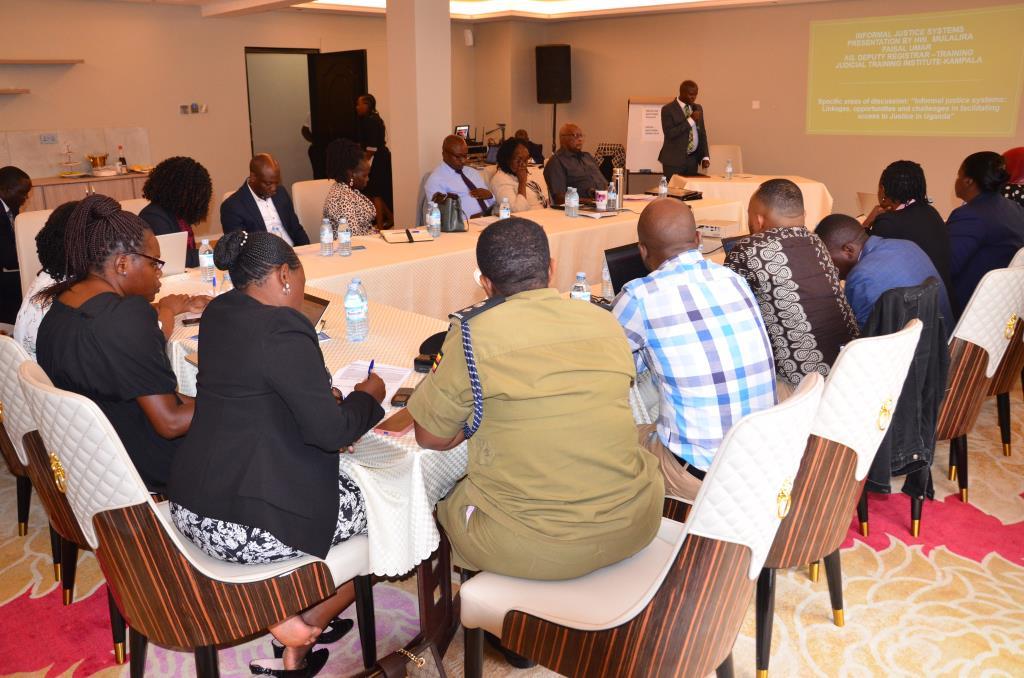
World Voices Uganda (WVU) in partnership with the International Development Law Organization (IDLO) has conducted a training of formal justice actors, including judicial officers, prosecutors, and other key JLOS actors, about the nature and operations of the informal justice systems.
The training was intended to deepen their understanding and appreciation of the role of informal justice systems as well as deepen their knowledge, and enhance linkages, referral pathways, and coordination.
This training further will enable the formal justice actors to provide technical support to the informal justice actors and this will increase uptake of informal justice systems in delivering justice services.
Jannipher Achaloi, from the International Organization Law Organization, the development partner organization, said this training is the first step and more specific tailored training will be undertaken in the future to ensure that justice is accessed by all Ugandans.
She was speaking during the two day training for formal justice actors about the nature and operations of informal justice actors at Meilin International Hotel, Nakasero in Kampala on Tuesday.
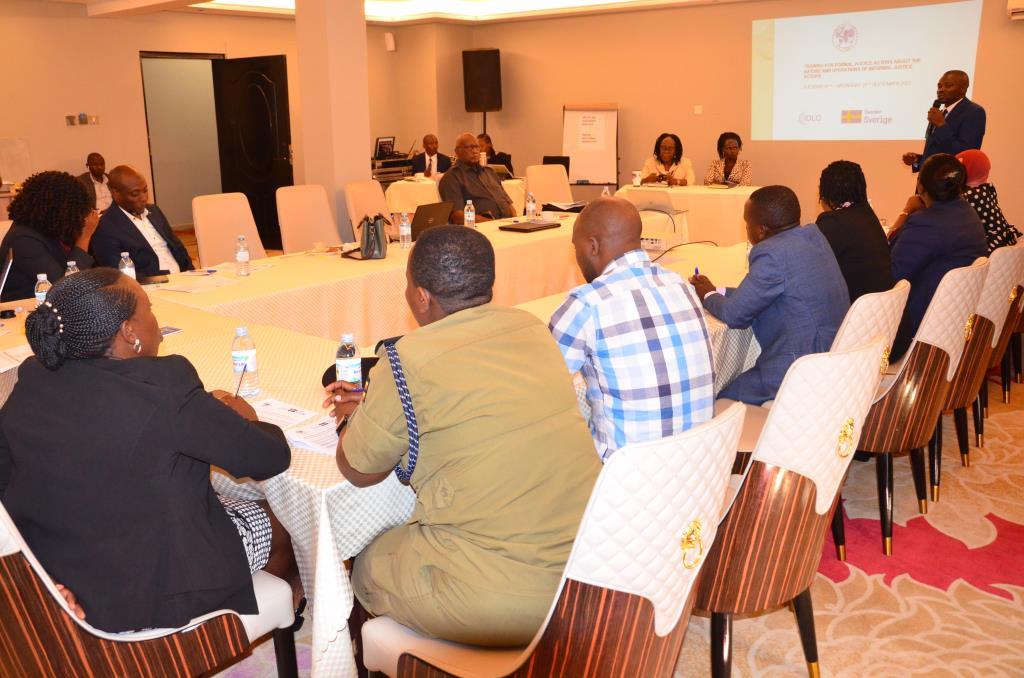

Theodora Webare Bitature, the Vice Chairperson Board WVU while giving opening remarks at the training for Formal Justice Actors said that Informal Justice system remains a cornerstone of our communities, training of the nature and operations of this system are a matter of human rights and social justice.
Webare said informal Justice Actors play a crucial role in maintaining peace and resolving disputes and asked the formal justice actors to provide them with the knowledge and skills so that they can provide justice services to the community.
Gard Benda, the Country Director World Voices Uganda said courts of law are clogged with a lot of cases which end up delaying justice to the vulnerable people.
Benda said World Voices Uganda began thinking around community access to justice driven models where the informal Justice Actors become handy in fulfilling this.
He said that reports indicate that over 80% of cases are handled outside the formal courts meaning that the Informal Justice Actors are at the center stage of ending crime in communities.
Hon Justice Patrick Tabaro, the retired Principal Judge who also specializes in arbitration and mediation said alternative dispute resolutions are important in effective delivery of justice.
Justice Tabaro further said in 1999 the United Kingdom introduced Alternative Dispute resolution to provide for dispute resolution and delivery of justice and it is still being used.
“After benchmarking in Canada, United Kingdom, USA and other countries, the idea of Alternative Dispute Resolution was adopted. The constitution itself obliges courts to promote mediation” Justice Tabaro said
Justice Tabaro said the informal Justice system is more understandable to the average person than the formal courts and if properly practiced it will solve problems in the society.
Justice Tabaro, served over thirty six (36) years in the Judiciary, starting out as a Magistrate in 1976 rising through the ranks to become a Constitutional Court Judge, Acting Principal Judge (President of the High Court) as well as serving as chairman of various Public Commissions of Inquiry and Specialized Courts such as the Non- performing Assets Recover Trust (NPART).
The National Development Plan (NDP) III makes critical commitments to multiply its efforts to transform the justice and law enforcement system into one that respects, promotes, protects, and fulfills the fundamental rights stipulated in the Constitution and the realization of the National Vision 2040.
Similarly, the Strategic Development Plan (SDP) IV of the Justice Law and Order Sector under the GSP objective 1.3 provides space for informal justice by supporting innovations and mechanisms that support bridging of informal and formal justice systems.
It recognizes the complementary role of informal justice to the formal justice systems. It has been recognized as a mechanism to enhance access to justice since it is rooted in processes that promote critical values of reconciliation and restorative justice. In Uganda, more than 80 percent of disputes are resolved using informal justice structures.
This scenario is attributed to the impracticalities around access to formal justice especially for the rural poor attributed to long distances since courts are located in urban centres, where the legal language is not understandable to an illiterate person, the exorbitant court fees, delayed judgments/delayed justice, bribery and corruption in some cases as well as the enormous case backlog to mention but a few.
As a result, the poor citizens continue to face grave human rights violations and a multitude of injustices without rescue.
The intervention of informal justice structures have since become a great channel for decongesting the formal courts and other formal mechanisms, hence reducing backlog. However, the informal justice systems have equally been accused of inadequate capacity to deal with complex aspects, inconsistencies in record keeping as well as faulting for not ensuring maximum quality assurance and strict adherence to principles of human rights, fair hearing, reporting and linkages with the formal justice.
While the complementarity of informal justice to formal justice is essential, there is a need for comprehensive deliberate efforts to promote attitudinal change, enhance structural linkages, and promote access to justice for the vulnerable. Capacity building for both stakeholders in formal and informal justice needs to be enhanced to pursue the linkages.
To strengthen informal justice as a complementary strategy, the formal justice actors need to fully appreciate the operations of informal justice systems.
This training is a build up to the baseline study that World Voices Uganda undertook in 2020 that made recommendations towards recognition of informal justice actors by formal justice actors.